Eye of Providence meaning: origins in Christian art
The Eye of Providence, also called the all-seeing eye, shows an eye framed by a triangle and often surrounded by rays of light. In Christian art the triangle stands for the Trinity and the eye for God’s watchful care over the world, which is providence. One early example is Jacopo Pontormo’s painting Supper at Emmaus (1525). By the seventeenth and eighteenth centuries the motif was common in European churches, books and engravings.
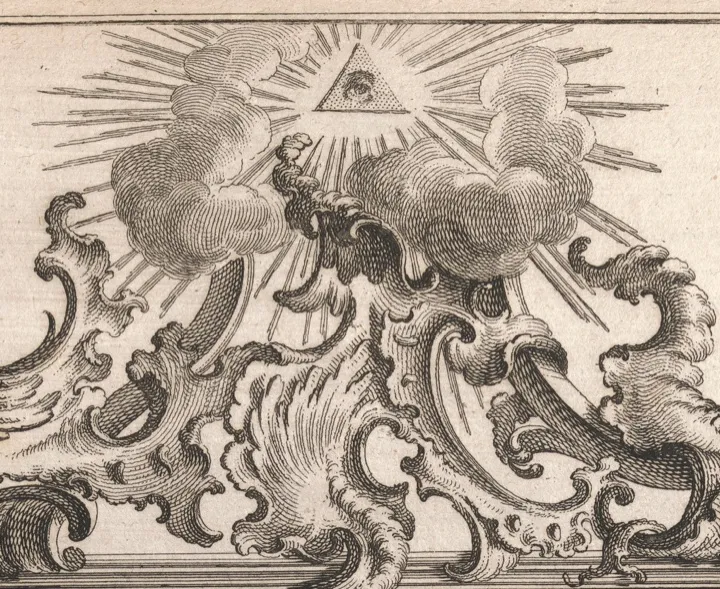 Detail of a design for a church pulpit crowned by the Eye of Providence, etching published by Martin Engelbrecht, Augsburg, about 1750–56. The Metropolitan Museum of Art, 2014.97.76, public domain.
The eye on the dollar bill and the Great Seal
The best-known Eye of Providence floats above an unfinished pyramid on the reverse of the Great Seal of the United States, which Congress adopted in 1782. Charles Thomson, Secretary of the Continental Congress, explained that the eye and the motto Annuit Coeptis (“He has favoured our undertakings”) referred to the many interventions of providence in favour of the American cause. The design has appeared on the one-dollar bill since 1935. See The Pyramid for the rest of the seal.
The eye was the seal’s earliest surviving idea. In 1776 the first seal committee, Benjamin Franklin, John Adams and Thomas Jefferson, consulted the artist Pierre Eugène du Simitière, who proposed an eye in a radiant triangle above a shield for the front of the seal. Congress rejected that design, but in 1782 William Barton placed the eye above his pyramid, and Thomson kept it. The official description of 1782 reads: “Over it an Eye in a triangle, surrounded with a glory proper.” In heraldry a “glory” is a ring of rays, and “proper” means shown in its natural colours.
The Masonic all-seeing eye
Freemasons adopted the all-seeing eye as a reminder that a higher power observes human conduct. It appears in Masonic publications from the 1790s, for example Thomas Smith Webb’s Freemason’s Monitor (1797). The Masonic eye usually appears without the triangle. Its use came after the Great Seal, not before it.
The seal was not a Masonic design. According to Masonic historians, Benjamin Franklin is the only man known to have been a Freemason among those who worked on it, and his own proposal, Moses dividing the Red Sea, did not include the eye. Du Simitière, who proposed the eye, was not a Mason. Both traditions drew on the same Christian emblem independently.
Is it an Illuminati eye?
There is no evidence that the Bavarian Illuminati used the Eye of Providence. The link was made by later writers, mostly because the Great Seal’s pyramid carries the date 1776 (MDCCLXXVI), the same year Weishaupt founded his order. That date marks the Declaration of Independence. The overlap is a coincidence that conspiracy literature has turned into a story.
For how this story developed, see New World Order and Conspiracy Theories.
In short: a Christian symbol of divine care, later used in American national symbolism and Freemasonry. Its association with the Illuminati is modern and unsupported.
Sources
- Jacopo Pontormo, Supper at Emmaus (1525), Gallerie degli Uffizi, Florence.
- Charles Thomson, “Remarks and Explanation” of the Great Seal, 20 June 1782, in Journals of the Continental Congress, vol. 22.
- Richard S. Patterson and Richardson Dougall, The Eagle and the Shield: A History of the Great Seal of the United States (Washington, D.C.: U.S. Department of State, 1976), on the three committees and du Simitière’s design.
- U.S. Department of State, Bureau of Public Affairs, The Great Seal of the United States (2003).
- Thomas Smith Webb, The Freemason’s Monitor; or, Illustrations of Masonry (Albany, 1797).