An ancient form
Pyramids were built as royal tombs in ancient Egypt. The Great Pyramid of Giza dates from around 2560 BC. They have stood for permanence, stability and achievement ever since, because few human works have lasted as long.
The pyramid on the Great Seal
The reverse of the Great Seal of the United States (1782) shows an unfinished pyramid of thirteen steps. It has the Roman numerals MDCCLXXVI (1776) on its base and the Eye of Providence above it. Thomson’s official explanation states that the pyramid signifies “Strength and Duration”. The thirteen layers echo the original thirteen states. The unfinished top suggests a nation still being built. The motto below, Novus Ordo Seclorum, means “a new order of the ages”. It was adapted from the Roman poet Virgil and refers to the new American era that began in 1776.
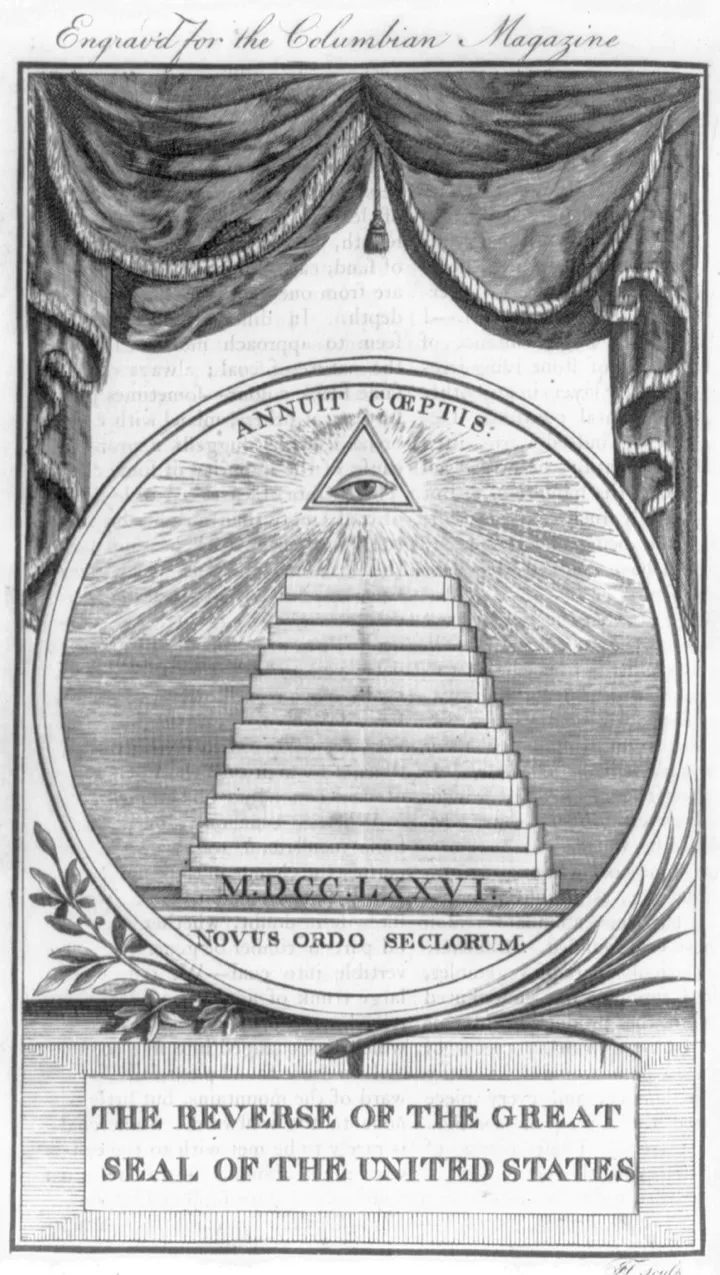 The reverse of the Great Seal, engraved by James Trenchard for the Columbian Magazine in 1786, one of its earliest published depictions. Library of Congress, public domain.
Who designed the reverse
Congress gave the design of a national seal to three committees between 1776 and 1782. The pyramid came from William Barton, a Philadelphia lawyer who advised the third committee in 1782. It was not a new idea: the Continental fifty-dollar note of 1778 already showed an unfinished pyramid of thirteen layers with the motto Perennis (“everlasting”).
Charles Thomson, Secretary of the Continental Congress, prepared the final version. He kept Barton’s pyramid and eye but replaced Barton’s mottoes with the two that appear today. Congress adopted the seal on 20 June 1782. Only the front of the seal has ever been cut as a die and used to seal documents. The reverse with the pyramid stayed a design on paper for over 150 years.
Great Seal symbolism: the mottoes and the date
Annuit Coeptis
Annuit Coeptis, above the eye, means “He has favoured our undertakings”. Thomson adapted it from Virgil. Sources differ on which passage he had in mind: Virgil uses the prayer audacibus annue coeptis (“favour my bold undertakings”) in the Georgics (I.40) and a close variant in the Aeneid (IX.625). In Thomson’s words, the eye and this motto “allude to the many signal interventions of providence in favour of the American cause”.
Novus Ordo Seclorum
Novus Ordo Seclorum, below the pyramid, is often translated as “New World Order”. That translation is wrong. Seclorum is a shortened form of saeculorum, “of the ages” or “of the generations”; the Latin for “world” (mundus) does not appear. The phrase echoes Virgil’s fourth Eclogue: magnus ab integro saeclorum nascitur ordo, “the great order of the ages is born anew”. Thomson explained it as “the beginning of the new American Æra”.
MDCCLXXVI meaning
The numerals on the base read 1776. Thomson stated that they give the date of the Declaration of Independence, and that the new era of the motto begins from it. The Bavarian Illuminati was also founded in 1776, on 1 May, two months before the Declaration. The seal’s designers never mentioned it, and nothing connects the two events except the year.
The pyramid on the dollar bill
The pyramid became familiar only in 1935. Secretary of Agriculture Henry A. Wallace saw the reverse in a 1909 State Department history of the seal by Gaillard Hunt and suggested putting it on a coin. President Franklin D. Roosevelt chose the one-dollar bill instead and asked for the two sides of the seal to be shown side by side. The design first appeared on the Series 1935 one-dollar silver certificate, and every one-dollar bill since has carried it. This is the image now popularly called the “Illuminati dollar bill”.
The “Illuminati pyramid of power”: how the myth began
Three coincidences fuelled the later legend:
- The date 1776, shared with the founding of the Bavarian Illuminati.
- The motto Novus Ordo Seclorum, often mistranslated as “New World Order”.
- The seal’s appearance on the one-dollar bill from 1935.
From these, conspiracy writers built a picture of a pyramid of power, with a hidden few at the top controlling the many below. This idea comes from twentieth-century interpretation. It does not come from the seal’s designers, and it does not come from the Bavarian order, which is not documented as using a pyramid at all.
For how the Great Seal entered conspiracy theory, see New World Order.
In short: an ancient symbol of permanence, used on the Great Seal for “strength and duration”. The “Illuminati pyramid” is a modern interpretation.
Related: The Eye of Providence · The Obelisk
Sources
- “Pyramids of Giza”, Encyclopaedia Britannica.
- Charles Thomson, “Remarks and Explanation” of the Great Seal, 20 June 1782, in Journals of the Continental Congress, vol. 22.
- Richard S. Patterson and Richardson Dougall, The Eagle and the Shield: A History of the Great Seal of the United States (Washington, D.C.: U.S. Department of State, 1976).
- Gaillard Hunt, The History of the Seal of the United States (Washington, D.C.: U.S. Department of State, 1909).
- Continental Currency, fifty-dollar note, 26 September 1778, Metropolitan Museum of Art collection.
- Virgil, Eclogues IV.5, source of the phrase adapted as Novus Ordo Seclorum.
- Virgil, Georgics I.40 and Aeneid IX.625, sources of the phrase adapted as Annuit Coeptis.