The Bavarian Illuminati (1776–1785) was a secret society, and like most secret societies of its time it protected its letters. Members wrote some words in a number cipher, dated their letters by a Persian calendar and used classical names for people and places. These practices are not speculation. The Bavarian government printed the order’s cipher, its calendar and examples of its coded letters in 1787.
Modern claims about “Illuminati numbers”, such as 13, 23, 33 and 666, are a different matter. None of them appears in the order’s papers. This article sets out what the documents show, then explains where the number claims came from.
Illuminati secret codes at a glance
| Code or number | Documented Illuminati use? | Where it comes from |
|---|---|---|
| Number cipher (a = 12 … z = 24) | Yes | Printed in the order’s papers, 1787 |
| Persian calendar | Yes | The order’s own dating system |
| Classical names for members and places | Yes | The order’s papers and correspondence |
| 13 | No | The thirteen states on the Great Seal; the 1990s “13 bloodlines” theory |
| 23 | No | The novel trilogy Illuminatus! (1975) |
| 33 | No | The degrees of the Scottish Rite of Freemasonry |
| 666 | No | The Book of Revelation, read into modern gestures |
Where the codes are recorded
On 11 and 12 October 1786, Bavarian officials searched the house of Franz Xaver von Zwackh, a former government councillor known in the order as “Cato”, in Landshut. The papers they found were printed in Munich in 1787, on the elector’s orders, as Einige Originalschriften des Illuminatenordens (“Some Original Writings of the Illuminati Order”). The preface says the volume was published to warn the public against the order, and invites anyone who doubts its authenticity to inspect the original manuscripts in the government’s secret archive.
The government published the papers to discredit the order, so they were selected with a purpose. But they are the order’s own documents, and historians still use them. Most of what is known about the Illuminati’s codes comes from this volume. The wider story of the order’s secrecy is told in our article on the Illuminati secret society.
The Illuminati number cipher
The volume prints a table headed Der schon bekannte Chiffre des Illuminaten-Ordens, “the already known cipher of the Illuminati Order”. The phrase “already known” suggests that it was no longer a secret by 1787.
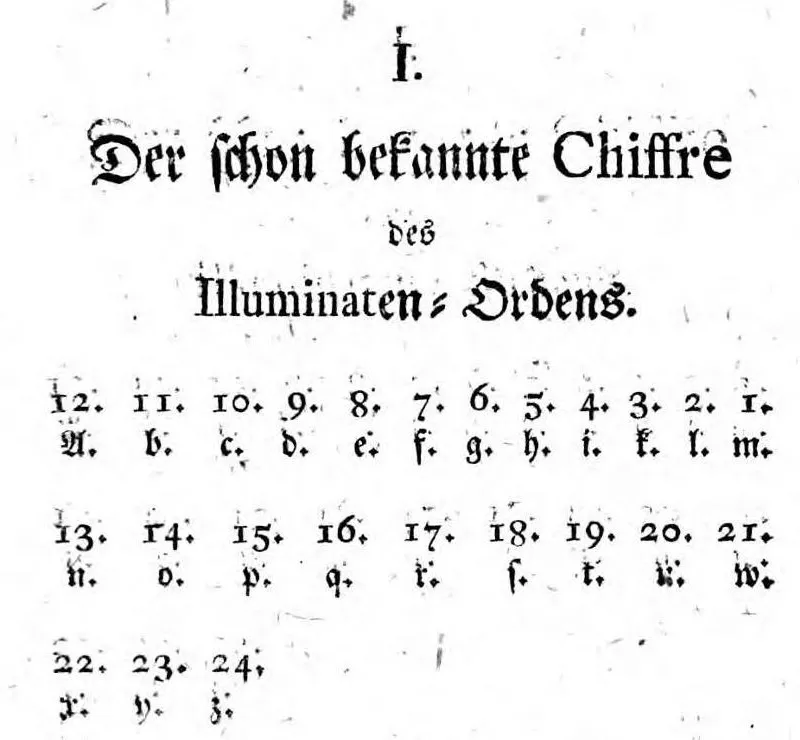 The Illuminati cipher as printed in Einige Originalschriften des Illuminatenordens (Munich, 1787). Public domain; scan from the Internet Archive.
The cipher replaces each letter with a number. The first half of the alphabet is numbered backwards and the second half forwards:
| a | b | c | d | e | f | g | h | i | k | l | m |
|---|---|---|---|---|---|---|---|---|---|---|---|
| 12 | 11 | 10 | 9 | 8 | 7 | 6 | 5 | 4 | 3 | 2 | 1 |
| n | o | p | q | r | s | t | u | w | x | y | z |
|---|---|---|---|---|---|---|---|---|---|---|---|
| 13 | 14 | 15 | 16 | 17 | 18 | 19 | 20 | 21 | 22 | 23 | 24 |
The table has 24 letters, with no separate j or v, which German alphabets of the time often treated as forms of i and u.
This is a simple substitution cipher. Each letter always has the same number, so anyone who has the table, or who notices which numbers occur most often, can read it. It kept a letter safe from a curious servant or postmaster, not from a determined government.
The cipher in a real letter
The 1787 volume shows how the cipher was used. In a letter answering one dated 28 December 1776, a member writes that his correspondent was told he would learn nothing for a set time about the age and government “des 14.17.9.8.13.18”, and adds “du hast’s in deinen 18.19.12.19.20.19.8.13”. With the table these read ORDENS (“of the Order”) and STATUTEN (“statutes”): “you have it in your statutes”. The government’s editors added a footnote telling readers to use the cipher table to read the words written in numbers.
So the cipher was not used for whole letters. It hid key words, such as the name of the order itself, in otherwise ordinary German.
More than one script
An earlier note in the volume, dated Ingolstadt, 19 July 1776, and written in the hand of the member code-named “Ajax”, records instructions given to a member. It ends: “His script is No. 3. Until further notice, unimportant matters in script No. 1.” The note implies that members were assigned numbered scripts or ciphers. The volume does not print the others, so what they looked like is not recorded here.
A cipher used to impress recruits
The cipher also had a theatrical use. The order’s instruction for recruiters, Instructio pro Recipientibus, advises arranging for a candidate to be present when a letter written in cipher arrives. The recruiter should open it and read it as if trying to hide it, “but so that the other can see the cipher”. Alternatively, he could leave such a letter half open on his table and put it away with the air of someone who does not like to be watched. The aim was to make the candidate curious about a hidden society before he was told anything about it. For how recruitment worked in general, see Illuminati Members and Secret Societies.
The Illuminati calendar
The same volume explains that “the order’s reckoning of time is the Yazdegerdian, or Persian”. It lists twelve Persian month names with their equivalents:
| Illuminati month | Equivalent |
|---|---|
| Pharavardin | 21 March to 30 April (41 days) |
| Adarpahascht | May |
| Chardad | June |
| Thirmeh | July |
| Merdedmeh | August |
| Schaharimeh | September |
| Meharmeh | October |
| Abenmeh | November |
| Adarmeh | December |
| Dimeh | January |
| Benmeh | February |
| Asphandar | 1 to 20 March (20 days) |
The year therefore began on 21 March, the spring equinox, as in the Persian calendar. Apart from the first and last, each month simply matched a European month.
The order’s years were 630 lower than European ones. In the 1787 volume, letters dated “Chardad 1148” follow letters of March 1778, and a letter dated “Abenmeh 1150” appears beside one of December 1780.
A worked example. A letter signed “Spartacus”, Adam Weishaupt’s code name, is dated “Eleusis, 13 Chardad 1148”. Eleusis was the order’s name for Ingolstadt, Chardad is June, and 1148 is 1778. The letter was written at Ingolstadt on 13 June 1778.
The calendar made dates meaningless to an outsider. It also gave the order an air of belonging to an older, non-Christian tradition of wisdom.
Secret names for people and places
Every member took a classical name: Weishaupt was “Spartacus”, Adolph Knigge “Philo”, Zwackh “Cato”. These names, and the best-known place names such as Munich (“Athens”) and Ingolstadt (“Eleusis”), are covered in Illuminati Members and Secret Societies.
The 1787 volume prints a fuller list of place names, which a note says was in Zwackh’s handwriting:
| Real name | Illuminati name |
|---|---|
| Bavaria | Achaia |
| Swabia | Pannonia |
| Franconia | Illyricum |
| Austria | Egypt |
| Tyrol | Peloponnese |
| Freising | Thebes |
| Augsburg | Nicomedia |
| Regensburg | Corinth |
| Nuremberg | Nicaea |
| Bamberg | Antioch |
| Eichstätt | Erzerum |
Together with the cipher and the calendar, these names turned a letter into something only another member could place and date: “Eleusis, 13 Chardad 1148” means nothing unless you know the system.
How the codes were exposed
The codes protected letters in the post, but they could not protect papers kept at home. When Bavaria banned secret societies in 1784 and named the Illuminati in 1785, the order’s documents became evidence. The searches of 1786 found the cipher, the calendar and the place names together with the letters that used them. Once they were printed in 1787, anyone could read the order’s coded correspondence. A system designed for secrecy ended up as a public explanation of how the secrecy worked.
Numbers linked to the Illuminati today
None of the following numbers appears as a code or symbol in the order’s papers. Each has a separate, documented origin.
- 13. The reverse of the Great Seal of the United States shows a pyramid of thirteen steps, for the thirteen original states, with the date MDCCLXXVI (1776). The seal’s designers never mentioned the Illuminati; see The Illuminati Pyramid. The “13 Illuminati bloodlines” are a conspiracy theory of the 1990s; see Illuminati Bloodline Families.
- 23. The link between 23 and the Illuminati comes from fiction. Robert Shea and Robert Anton Wilson’s satirical novel trilogy Illuminatus! (1975) made the number part of its invented Illuminati mythology. Wilson said he learned of the “23 enigma” from the writer William S. Burroughs.
- 33. Thirty-three is the highest degree of the Scottish Rite, a branch of Freemasonry whose first Supreme Council was formed at Charleston, South Carolina, in 1801, years after the Illuminati was suppressed. It belongs to Masonic history, not to the Illuminati; see Freemasonry and Freemasons.
- 666. The “number of the beast” comes from the Book of Revelation (13:18). Claims that people signal it with their hands are discussed in Illuminati Hand Signs, and its religious background in Illuminati and Religion.
How to check a claimed “Illuminati code”
- Look for it in the order’s papers. The cipher, calendar and code names are printed in the 1787 volume and in the modern edition of the order’s correspondence. A code that appears in neither has no documented link to the historical order.
- Find the first person to make the claim. A meaning first proposed in the 1970s or later is an interpretation, not evidence.
- Check the number’s own history. Thirteen, thirty-three and 666 have well-documented meanings in American, Masonic and biblical history.
- Remember the dates. The order existed for less than a decade. A code said to appear in modern films, logos or music would have to be used by an organization that historians have found no evidence of after the 1780s.
Illuminati secret codes FAQ
Did the Illuminati have a secret code?
Yes. The Bavarian Illuminati used a number cipher for key words, a Persian calendar for dates, and classical names for members and places. All three are documented in the order’s papers, printed by the Bavarian government in 1787.
How does the Illuminati cipher work?
Each letter is replaced by a number. The letters a to m are numbered 12 down to 1, and n to z are numbered 13 up to 24. For example, 14.17.9.8.13 spells Orden, “order”.
What year is it in the Illuminati calendar?
The order counted years 630 lower than the European calendar, starting on 21 March. The year 1148 began in March 1778. The order was suppressed in the 1780s, so its calendar has no modern use.
Are 13, 23 and 33 Illuminati numbers?
No. None appears as a code in the order’s papers. Thirteen comes from the Great Seal and the 1990s bloodlines theory, 23 from the novel Illuminatus! (1975), and 33 from the degrees of the Scottish Rite of Freemasonry.
In short: the historical Illuminati really did use secret codes: a simple number cipher, a Persian calendar and classical names. They are documented because the Bavarian government printed them in 1787. The famous “Illuminati numbers” have other, later origins.
Related: The Illuminati Secret Society · Illuminati Members and Secret Societies · Illuminati Hand Signs · Conspiracy Theories
Sources
- Einige Originalschriften des Illuminatenordens, welche bey dem gewesenen Regierungsrath Zwack durch vorgenommene Hausvisitation zu Landshut den 11. und 12. Oktob. 1786 vorgefunden worden (Munich: Joseph Lentner, 1787): the cipher table, the calendar, the place names, the Instructio pro Recipientibus, and the letters and notes quoted above. Digitized copy on the Internet Archive.
- Reinhard Markner, Monika Neugebauer-Wölk and Hermann Schüttler (eds.), Die Korrespondenz des Illuminatenordens (Tübingen: Niemeyer, 2005–2013).
- Richard van Dülmen, Der Geheimbund der Illuminaten (Stuttgart: Frommann-Holzboog, 1975).
- FactGrid, Illuminati research database (calendar and documents), Gotha Research Centre, University of Erfurt.
- Robert Shea and Robert Anton Wilson, Illuminatus! (New York: Dell, 1975); Robert Anton Wilson, Cosmic Trigger I (1977), on the “23 enigma”.
- Supreme Council, 33°, Ancient and Accepted Scottish Rite, Southern Jurisdiction (founded Charleston, 1801).
- Book of Revelation 13:18.